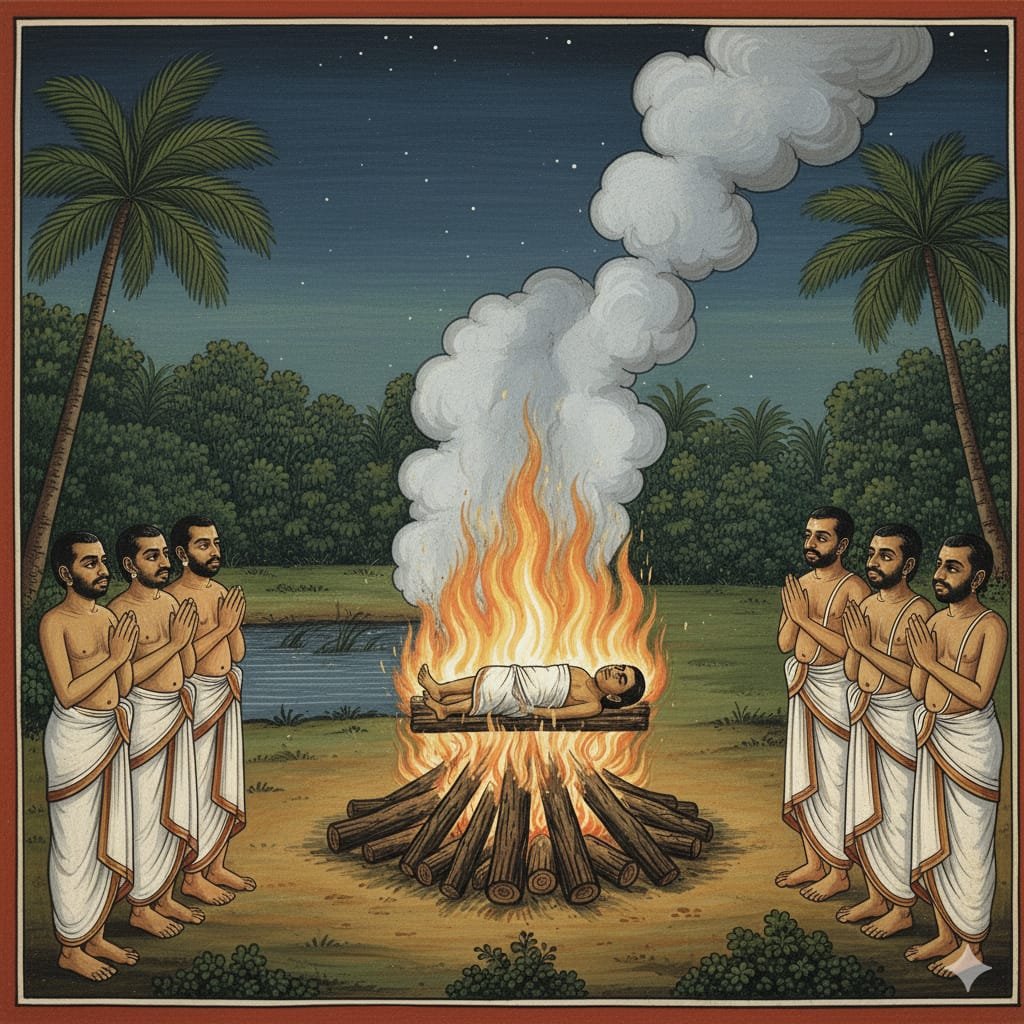
Aryamba: The Beloved Mother
Aryamba hailing from Melpazhoor Mana, wife of Sivaguru of EDAMANA( Kappilly) had a son after much prayers by the couple at Lord Vadakkumnathn temple Trissivaperoor (Trissur).
Lord Shiva put a puzzle before the parents whether they need a leaned son but short lived or a son with long life , but dumb. Definitely it is father Shivaguru who took the call and asked for an intelligent prodigy, where no mothers could compromise on her son’s life span.
Sivaguru shortly after Upanayana Samsakarm of his son, passed away- may be leaving his rest of life span to his son, thus mother of Śrī Śaṅkarāchārya, became a widow early in Shakara’s life.
Then on, it was all a saga of deep filial bondage between the little prodigy and his beloved mother.
- Starting from changing the course of the river to the house for mother
- When 8 of the 10 Nambudiri families around outcasted Shankara and his only supportive family for supporting his most unorthodox ways challenging untouchability and cast discriminations
- Getting Sannyasa permission from mother following incident of crocodile grab of Little Shankara
- Agreeing to be back to her side when she really wants her son to be beside her.
- Stood with Shankara when he left Kerala in search of Guru when the community within Kerala deprived the family of Vedic rights, but with heaviest of heart
- Bore the shock of her brother burning the Entrance gate of her own house at Pazhoor, and chased his nephew out when Shankara tried to be at his Uncles..(Ammath)
- Was very much over-joyed when each news of achievements and recognition of great scholarly son was reaching as music to her old age ears
- Till her last breath she was looking forward to have his son around. Thereafter it was her family members of EDAMANA who carried her mortal body holding leg side to pyre later nick named KAPPILLY and Kin family MOOTHEDAM carrying head side later nick named as THALA ETTUM PILLY. From among the 10 community members in the village or even MELPAZHOOR – the house ARYAMABA refused to take part.
- Her beloved son Shankara came below the Ashoka tree, where under her mortal remains were deposited after cremation and Atma- stayed back to receive final rites. The deeply repenting son for his absence to be beside her as promised to mother while departing KALADY, broke down.
- He prostrated the depth of motherly love in 5 stanzas later famous as MATHRU PANCHAKAM
- 1. Aasthaam tavaddeyam prasoothi samaye durvara soola vyadha,
Nairuchyam thanu soshanam malamayee sayya cha samvatsaree,
Ekasyapi na garbha bara bharana klesasya yasya kshmo dhathum,
Nishkruthi munnathopi thanaya tasya janyai nama.
Oh mother mine,
With clenched teeth bore thou the excruciating pain,
When I was born to you,
Shared thou the bed made dirty by me for an year,
And thine body became thin and painfull,
During those nine months that you bore me,
For all these in return,
Oh mother dearest,
I can never compensate,
Even by my becoming great.
- 2. Gurukulamupasruthya swapnakaale thu drushtwa,
Yathi samuchitha vesham praarudho maam twamuchai
Gurukulamadha sarva prarudathe samaksham
Sapadhi charanayosthe mathurasthu pranaama.
Clad in a dress of a sanyasin,
You saw me in my teacher’s school,
In your dream and wept,
And rushed thither,
Smothered, embraced and fondled me, Oh mother mine,
And all the teachers and students wept with you dear,
What could I do,
Except falling at your feet,
And offering my salutations.
- 3. Ambethi Thathethi Shivethi tasmin,
Prasoothikale yadavocha uchai,
Krishnethi Govinda hare Mukunde tyaho,
Janye rachito ayamanjali.
Oh mother mine,
Crying thou shouted in pain,
During thine hard labour,
“Oh mother, Oh father,
Oh God Shiva,
Oh Lord Krishna,
Oh Lord of all Govinda,
Oh Hari and Oh God Mukunda,”
But in return,
Oh my mother dearest.
I can give you but humble prostrations.
- Na dattam mathasthe marana samaye thoyamapi vaa,
Swadhaa vaa no dheyaa maranadivase sraadha vidhina
Na japtho mathasthe marana samaye tharaka manu,
Akale samprapthe mayi kuru dhayaam matharathulaam.
Neither did I give you water at thine time of death,
Neither did I offer oblations to thee to help thine journey of death,
And neither did I chant the name of Rama in thine ear,
Oh Mother supreme, pardon me for these lapses with compassion,
For I have arrived here late to attend to those.
- Mukthaa Manisthvam, Nayanam mamethi,
Rajethi jeevethi chiram sthutha thwam,
Ithyuktha vathya vaachi mathaa,
Dadamyaham thandulamesh shulkam.
Long live,
Oh, pearl mine,
Oh jewel mine,
Oh my dearest eyes,
Oh mine prince dearest,
And oh my soul of soul,
Sang thou to me,
But in return of that all,
Oh my mother dearest.
I give you but dry rice in your mouth.
- Bereaved Shankara has done the initial aparakriya for his mother in the Ghat below the Ashoka tree, and asked his family to continue lighting lamp below the mortal remains till he comes back within a year to do the final rites and Sapindeekararanam and 1st annual Shradham as the rituals required. But unfortunately again, the son could not return.
- The Kappilly family continued with this practice of ritualistic lamp to solace the atma of mother for generations after generations. To facilitate the daily Lamp, Thekkemadom donated a black lamp post inscribed around it THEKKE MADOM VAKA in Malayalam script which was formed as such in 16th -17th Centaury.
- The tradition of ritualistic lamp by family was stopped by Sree Sree Sringeri Sarada Peetam by forcefully taking over the property from family of the great Guru Shankaracharya using royal influence and cutting off the Ashoka tree erasing the protective wall and refusing the ritualistic lamp of tradition to the helpless Atma of Mother Aryamba, all in the name PRESRVATION
The Unfulfilled Duty (Ātmaa and Abode)
The Acharya’s own words in the Mātru Pañchakam (verse 4) record his great anguish at not being able to attend his mother in her final moments or perform the subsequent Śrāddha (final rites). This is direct testimony to an unfulfilled filial obligation:
“Neither did I give you water at the time of your death, nor perform the Śrāddha… O Mother, pardon me.”
Because Ādi Śaṅkara could not return to perform the complete final rites (śeṣakriyā and sapindīkaraṇam), her soul, according to ritual custom, was left ritually incomplete in its passage to Pitṛloka, remaining bound to the mortal remains. This led to her cremation site being kept as a simple tomb marked by the lamp—an exception to the Nambudiri custom of returning the site to agriculture after all rites are completed.