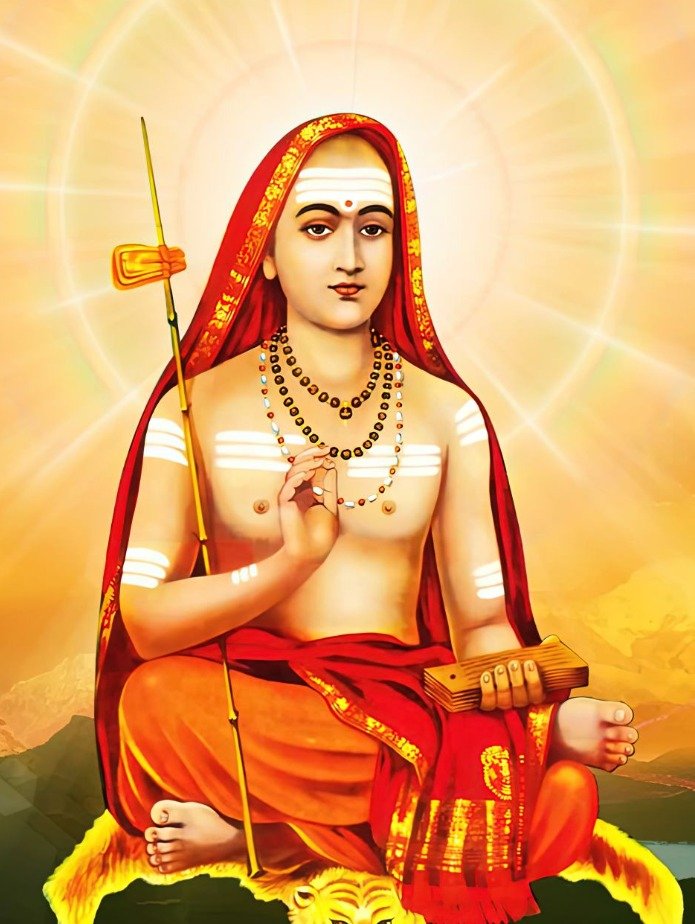
Śrī Śaṅkarāchārya: The Guru and the Son
Ādi Śaṅkarāchārya, the renowned philosopher and Guru, was the son of Sivaguru of EDAMANA (Late Kappilly) and Aryamba of Mel Pazhoor . Despite his universal greatness, his personal life was marked by the profound sorrow of an unfulfilled filial duty to his mother. In Prabodhasudhakaram -the only work where Achrya has been introspected and commented on self, thanking his Yadukuladevan ancestral lord Krishna that “I am bestowed with and blessed with immense self- knowledge though initially you have ignored us in life struggles “
Even as a child, little Shankara had the inner spirit of Advaitha within him. The very conservative Nambudiri community, he was never accepting concept of community superiority and was mixing up with the society freely within untouchability of “Theendal and Thodeel”. This provoked the community and ended up in excluding both paternal house EDAMANA and kin family who still associated with little Shankara and stood with him. As such, they were ripped off of Veda Adhikara , the right to learn and recite Vedas allowing only priestly activities as YATRA Namboothiri.
In fact, for further studies as a seeker Shankara had to search Guru outside the Namboothiri caste limits. This also reflected when mother of Shankara passed away. Only EDAMANA and MOOTHEDAM had done the cremation in absence of Shankara when the other 10 Nambudiri families continued non-cooperation. Even EDAMANA who took leg part of mother ARYAMBA to pyre and kin family MOOTHEDAM where nick named as KAL-ettum -PILLY [KAPPILLY] Leg side and Thala (head ettum Pilly [THALAYATTUMPILLY]. Nambudiris of Kerala never accepted Shankara and Advaitha practice.
The Mātru Pañchakam captures the Guru’s lasting pain over this. His inability to complete the final rites was a wounding in his filial duty vow, which has remained a family and dharmic obligation.
The events of 1906 and 1910, while formally affirming Kalady as his birthplace and granting it institutional glory, ironically silenced the daily lamp of respect and ended the natural guardianship of his family over Aryamba’s resting place. This pursuit of universal recognition came at the cost of his mother’s natural sanctuary.